Simulation-based consulting for mineral processing, engineering studies and plant performance evaluation.
EPM applies DPSIM to support mineral processing teams in building representative process models, reviewing flowsheet performance, comparing operating scenarios and translating simulation results into engineering decisions.
DPSIM is not only a software product in EPM projects. It is the engineering environment used to organize assumptions, represent circuit behavior, evaluate alternatives and communicate results with a clear technical basis.
What EPM Does
Mineral processing projects often require more than a mass balance. Engineering teams need to understand how the circuit behaves, where bottlenecks appear, how operating conditions affect product quality, and which assumptions are driving the results.
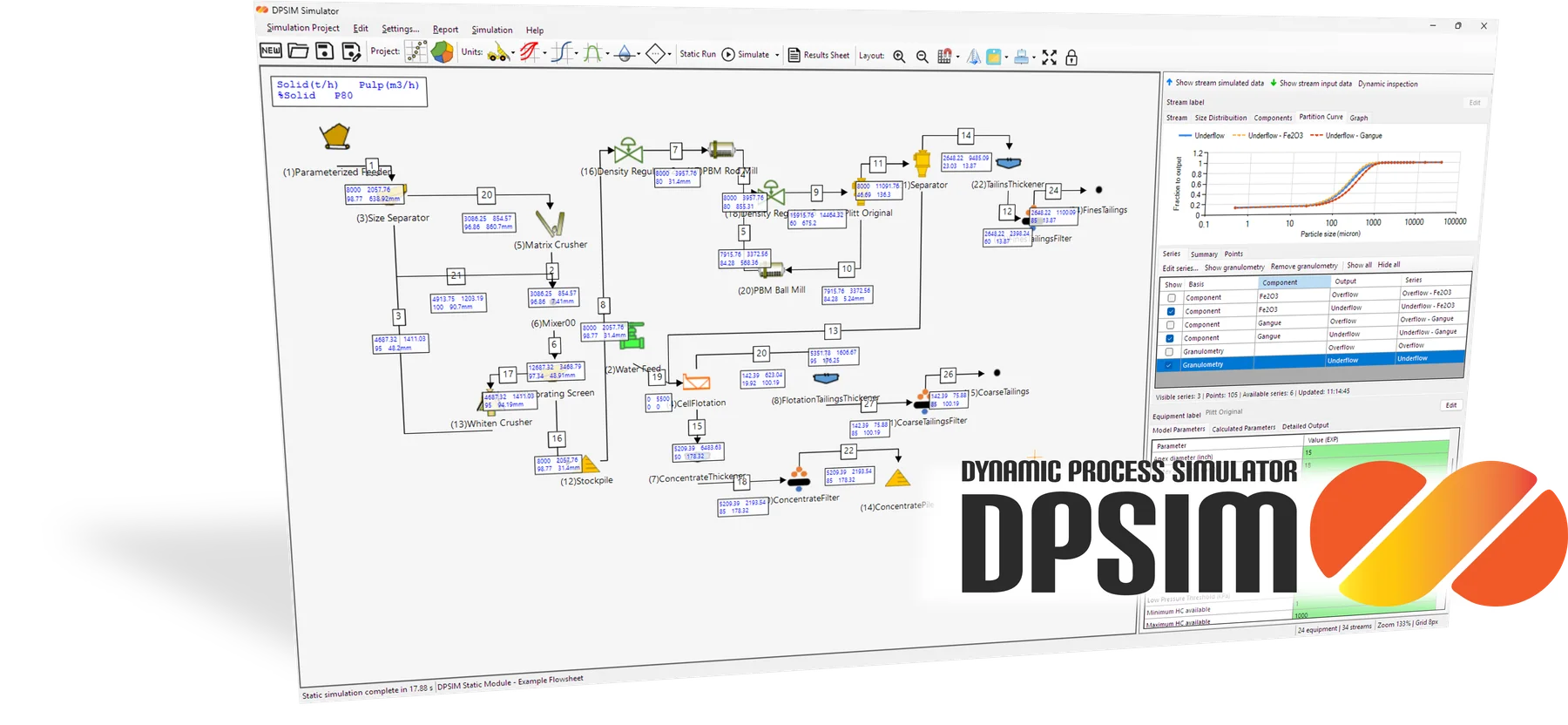
EPM supports this work through process simulation and technical review using DPSIM. The objective is to help engineers move from process data and assumptions to practical decisions about design, operation, reliability and improvement opportunities.
Depending on the study, EPM can support steady-state simulation, dynamic simulation, reliability analysis, control logic evaluation, model review and DPSIM training.
Consulting Areas
Steady-State Simulation Studies
Steady-state simulation is useful when the objective is to evaluate average operating conditions, review mass balances, compare process alternatives or support design decisions.
EPM can support:
- flowsheet model development;
- mass balance and water balance review;
- unit operation model configuration;
- scenario comparison;
- process capacity evaluation;
- technical reporting for engineering review.
Dynamic Simulation Studies
Some questions cannot be answered well with a steady-state snapshot. When time-dependent behavior matters, dynamic simulation becomes more appropriate.
EPM can support DPSIM Full studies involving:
- feed rate and grade disturbances;
- changing operating conditions;
- equipment start-up and shutdown logic;
- stockpile, bin, sump and tank inventory behavior;
- recirculating loads and transient responses;
- control rules and operator actions;
- scenario comparison over time.
Reliability and Production Risk
Equipment availability does not always translate directly into plant production. A failed equipment item may stop the entire plant, reduce capacity, or have little immediate impact depending on buffers, standby equipment, bypasses and operating logic.
EPM can use DPSIM Full to evaluate:
- equipment failure and repair assumptions;
- MTBF and MTTR-based scenarios;
- standby equipment and redundancy;
- stockpile and buffer behavior;
- lost production;
- utilization and availability indicators;
- critical equipment and bottleneck sensitivity;
- production risk under different operating strategies.
Model Review and Training
EPM can also support engineering teams that are adopting DPSIM or reviewing existing simulation work.
This may include:
- review of flowsheet structure;
- review of model assumptions;
- interpretation of model parameters;
- comparison between plant data and simulation results;
- setup of DPSIM workflows for internal studies;
- training sessions for engineers and technical teams.
Typical Study Outputs
Depending on the project scope, an EPM study may include:
- reliability and production-impact indicators;
- comparison of operating scenarios;
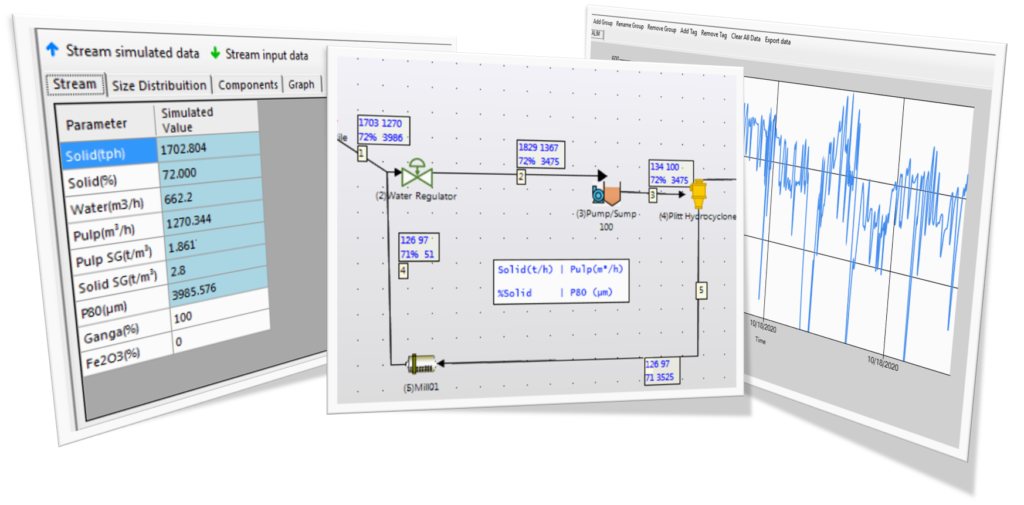
- dynamic simulation timelines;
- mass balance and water balance summaries;
- a structured DPSIM flowsheet model;
- reviewed or calibrated unit operation parameters;
- equipment capacity and bottleneck analysis;
- a technical report with assumptions, results and recommendations.
Technical Leadership

EPM is led by Dirceu Nascimento, mining engineer with more than 15 years of experience in mineral processing. He is the developer of DPSIM.
Dirceu combines mineral processing experience with software development, allowing EPM to support workflows involving process dynamics, material handling, equipment availability, maintenance events and control logic.
Through EPM, clients can access not only DPSIM software capabilities, but also engineering support to structure assumptions, interpret results and apply simulation to practical mineral processing decisions.
From Simulation to Engineering Decisions
A process simulation is valuable when it improves the quality of a decision.
EPM combines mineral processing knowledge with DPSIM modeling workflows to help engineering teams understand circuit behavior, identify risks, compare alternatives and communicate results before changes are made in the plant or project.
Whether the objective is design review, operational improvement, production risk evaluation or training, EPM helps turn flowsheet models into engineering insight.
Have a flowsheet, study or plant problem to evaluate?
Contact EPM to discuss how DPSIM can support your mineral processing study.