Connect equipment failures, repairs, buffers and operating rules to plant production over time.
Reliability with DPSIM is an advanced DPSIM Full workflow for evaluating how equipment failures, repair events, standby logic, buffers, operating states and maintenance assumptions affect mineral processing plant performance over time.
Instead of only calculating whether an equipment item is available, DPSIM Full helps evaluate how equipment states affect throughput, inventories, utilization, bottlenecks and production losses across the flowsheet.
DPSIM Static Module does not include reliability simulation, dynamic simulation or process control workflows. The Static Module is focused on steady-state flowsheet simulation, model reference review and engineering reporting.
Why Use DPSIM Full for Reliability?
In mineral processing, the production impact of a failure depends on more than the failed equipment.
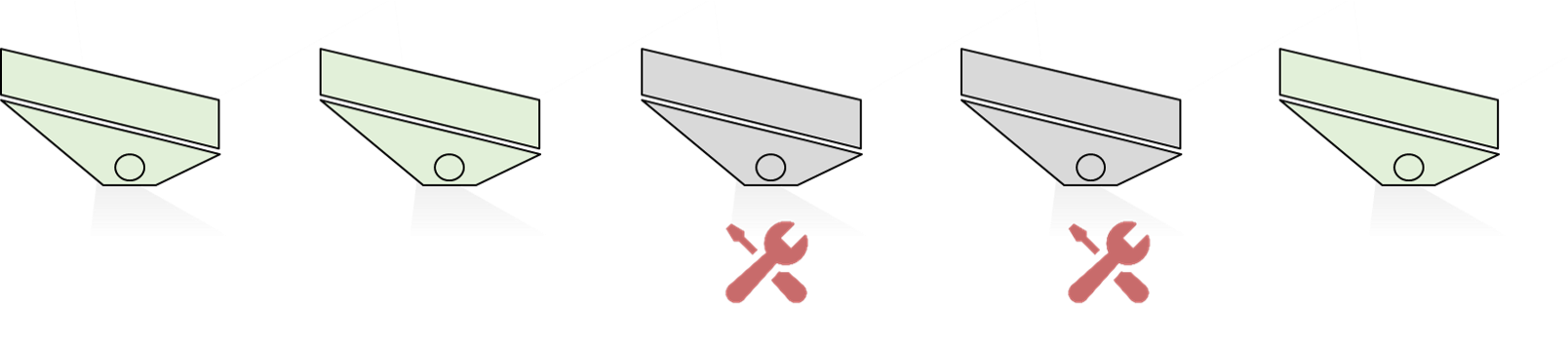
A conveyor failure may stop the plant immediately, or it may have limited short-term impact if downstream equipment can continue operating from a stockpile. A downstream failure may stop upstream equipment, or it may be absorbed temporarily by available storage capacity. A standby pump may reduce production loss, but only if switching logic, detection time and startup delay are properly represented.
DPSIM Full is designed to evaluate this type of time-based behavior by combining reliability assumptions with process simulation, material inventories and operating logic.
Traditional availability calculation
Equipment-level indicator. Useful for first-pass screening, but limited for production impact.
DPSIM Full reliability simulation
Time-based flowsheet behavior with failures, repairs, inventories, operating states and production results.
From Component Availability to Production Impact
A simple availability calculation can identify weak equipment items. However, plant production depends on how each failure propagates through the circuit.
DPSIM Full connects reliability events to flowsheet behavior so that failures and repairs are evaluated in the context of:
- process capacity;
- stream connections;
- recirculating loads;
- stockpile, bin, tank and sump inventories;
- standby equipment;
- partial-capacity operation;
- operating rules;
- maintenance and restart assumptions.
This allows engineers to move from the question “is this equipment available?” to more practical questions such as:
- how much production is lost?
- when does the loss occur?
- which equipment creates the largest production impact?
- how much buffer capacity is useful?
- does redundancy improve the result?
- which operating rule reduces downtime or lost production?
What DPSIM Full Can Represent
DPSIM Full reliability workflows can represent:
- equipment failure and repair events;
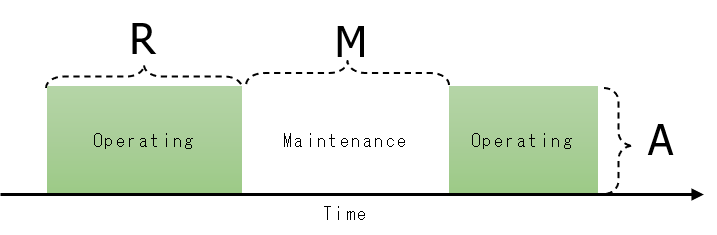
- MTBF and MTTR-based assumptions;
- planned or unplanned equipment interruptions;
- operating states such as running, stopped, failed, under repair, waiting, idle or constrained;
- standby equipment and switching logic;
- buffers, stockpiles, bins, tanks and sumps;
- partial-capacity operation;
- upstream and downstream constraints;
- control rules and operating strategies;
- scenario comparisons for maintenance, redundancy and bottleneck mitigation.
Typical Reliability Study Inputs
A reliability study in DPSIM Full may use inputs such as:
- equipment list and flowsheet boundaries;
- equipment capacities and operating limits;
- MTBF, MTTR or other failure and repair assumptions;
- planned maintenance assumptions;
- startup, shutdown and restart delays;
- standby equipment rules;
- repair priority or maintenance constraints;
- stockpile, bin, tank and sump capacities;
- initial inventory levels;
- feed assumptions and operating scenarios;
- rules for stopping, restarting, bypassing or reducing capacity.
Typical Study Outputs
Depending on the project scope, DPSIM Full reliability results may include:
- plant operating hours;
- plant availability and utilization indicators;
- production loss by scenario;
- downtime contribution by equipment;
- equipment state timelines;
- inventory trends for buffers and stockpiles;
- bottleneck and critical-equipment ranking;
- comparison of redundancy or standby strategies;
- evaluation of buffer capacity;
- sensitivity to MTBF, MTTR or repair assumptions;
- plots, tables and exported results for engineering review.
Typical Workflow
A DPSIM Full reliability workflow typically includes:
- Build or review the process flowsheet and define the equipment boundaries relevant to the study.
- Define reliability and repair assumptions, including MTBF, MTTR, standby logic and maintenance constraints where applicable.
- Represent buffers, stockpiles, equipment states and operating rules that influence production continuity.
- Run time-based scenarios and compare availability, utilization, lost production and bottleneck behavior.
- Review results with the project team and refine assumptions using plant data, vendor data or maintenance history.
Example Study Questions
Reliability with DPSIM can support questions such as:
- Which equipment failures have the greatest impact on plant production?
- How much intermediate storage is required to protect downstream operation?
- Does a standby equipment item reduce lost production enough to justify its use?
- Which section of the plant is most sensitive to repair time?
- How does a maintenance strategy affect annual production?
- What is the difference between equipment availability and actual production availability?
- Which bottlenecks only appear when failures, inventories and operating rules are simulated together?
DPSIM Static Module and DPSIM Full
The DPSIM Static Module is the free public release for steady-state simulation, model review and engineering reporting. It is useful for flowsheet setup, mass balance work and communication of steady operating cases.
DPSIM Full is used for advanced project applications such as dynamic simulation, process control studies and reliability analysis. Contact EPM if your study requires these capabilities.
Need to evaluate how failures and repairs affect plant production?
EPM can support DPSIM Full reliability studies for mineral processing circuits, including scenario definition, model setup, reliability assumptions, dynamic simulation and engineering interpretation of results.