Turn flowsheets, material data and process models into engineering insight.
Mineral process simulation helps engineers understand how a processing plant behaves before changes are made in design or operation. By combining material streams, unit operation models and flowsheet logic, a simulator can estimate mass balances, water balances, product quality, circulating loads, equipment duties and the impact of alternative operating conditions.
DPSIM applies this approach to mineral processing circuits, supporting both steady-state simulation through the public DPSIM Static Module and advanced project-specific studies with DPSIM Full.
Why Simulate a Mineral Processing Plant?
Mineral processing circuits are highly interconnected. A change in one unit operation can affect circulating load, water balance, particle size distribution, recovery, product quality and downstream equipment performance.
Simulation provides a structured way to evaluate these interactions. Instead of reviewing each equipment item in isolation, engineers can represent the complete flowsheet and test how the circuit responds to different assumptions.
Mineral process simulation can support questions such as:
- What is the expected mass and water balance for this circuit?
- Which equipment or stream is limiting plant capacity?
- How does a change in feed rate, feed size or ore type affect the plant?
- What happens if a screen aperture, cyclone cut size or flotation recovery changes?
- Is the proposed flowsheet configuration consistent with the project objectives?
- Which assumptions have the greatest effect on production, recovery or product quality?
How Mineral Process Simulation Works
At its core, a mineral process simulator combines three elements:
- material streams, which describe the ore, water and slurry moving through the plant;
- unit operation models, which calculate how equipment transforms or separates the feed;
- a flowsheet, which connects the units and defines how material moves through the circuit.
The simulator uses the feed stream description and the selected equipment models to calculate output streams. These output streams then become feed streams for downstream units. In this way, the simulator links individual equipment behavior into an overall representation of plant performance.
This is important because the value of simulation is not only in calculating a single unit operation. The value is in understanding how the units interact across the flowsheet.

Material Streams and Particle Properties
In mineral processing, the material is not a simple fluid. It is usually a particulate solid carried with water, and its behavior depends on properties such as particle size, mineral composition, density and solids concentration.
DPSIM represents material streams using properties such as:
- solids flow rate;
- water flow rate;
- component or mineral distribution;
- slurry density;
- percent solids;
- particle size distribution;
- size-by-component information when required by the model.
This level of representation is important because many unit operations respond differently to different particle classes. For example, a hydrocyclone, screen, mill or flotation model may depend on both particle size and component distribution.
Unit Operation Models
Each unit operation in the flowsheet is represented by a mathematical model. The model receives a feed stream, applies equations or empirical relationships that represent the equipment behavior, and calculates one or more product streams.
DPSIM model families include:
- feeds and stream splitters;
- crushing and grinding;
- screening and classification;
- hydrocyclones;
- flotation and concentration;
- dewatering;
- material handling;
- auxiliary operations.
From Unit Models to Flowsheet Behavior
A mineral processing plant is more than a collection of equipment. It is a network of streams, recirculating loads, separation stages, water additions and operating constraints.
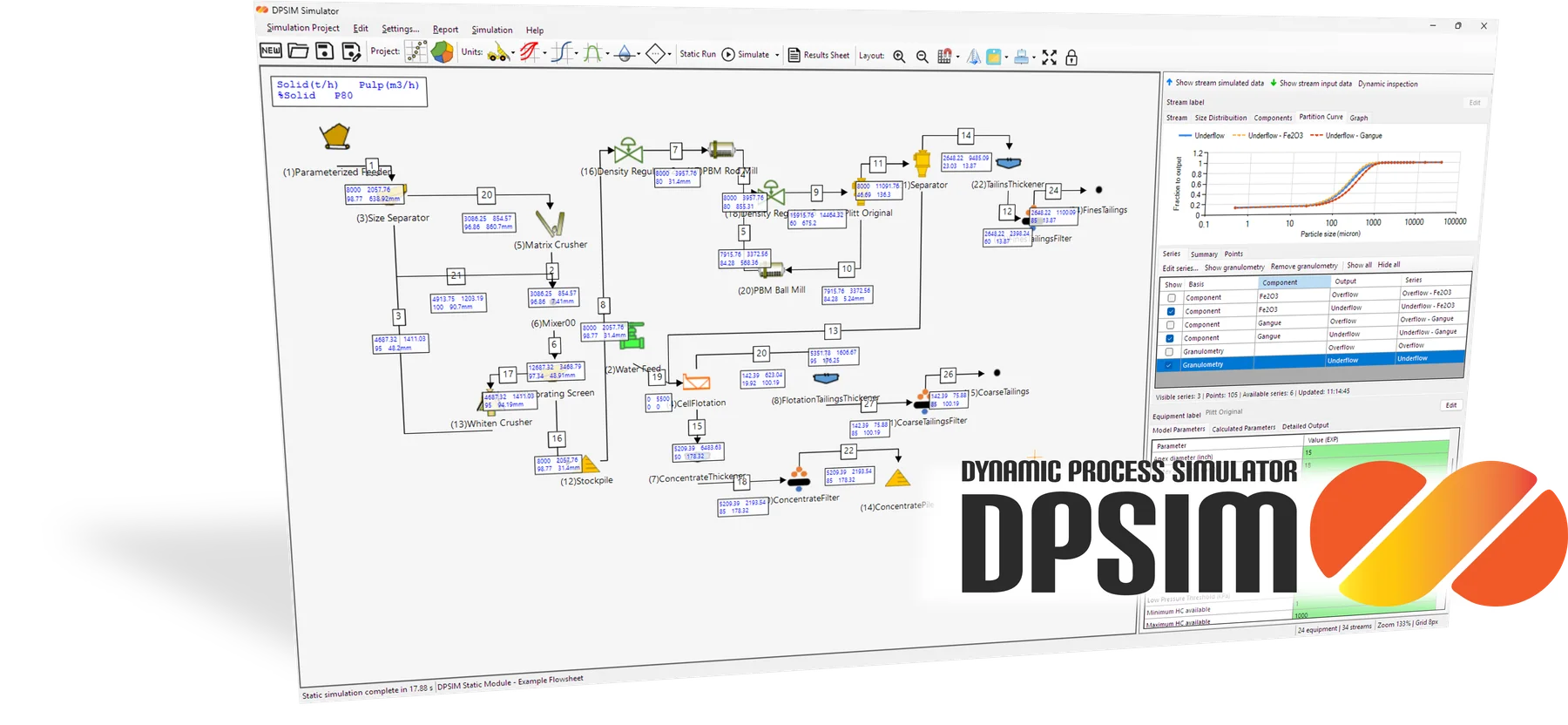
DPSIM organizes these elements in a flowsheet workspace so that engineers can build a representative circuit, connect streams, configure models and evaluate the resulting plant behavior.
This flowsheet-based approach helps engineers move from isolated calculations to process-level understanding. A change in one unit can be evaluated not only by its local effect, but also by its impact on the downstream and recirculating parts of the circuit.
Static and Dynamic Simulation
Mineral process simulation can be applied in two main ways: steady-state simulation and dynamic simulation.
Static Simulation
Static, or steady-state, simulation represents the plant under a stable operating condition. It assumes that the selected feed, equipment settings and operating assumptions remain constant for the calculation basis.
Static simulation is useful for:
- mass balance review;
- water balance review;
- equipment sizing support;
- comparison of flowsheet alternatives;
- average production estimates;
- circuit performance evaluation;
- engineering communication and reporting.
The DPSIM Static Module focuses on this public steady-state workflow.
Dynamic Simulation
Dynamic simulation represents how the plant evolves over time. Instead of calculating only one stable condition, it updates the flowsheet through time steps and captures changing operating conditions.
Dynamic simulation is useful when the study involves:
- feed rate or grade disturbances;
- equipment start-up and shutdown;
- stockpile, bin, tank or sump inventories;
- control rules and operator actions;
- equipment availability;
- failure and repair events;
- transient behavior and production risk.
Dynamic simulation is a DPSIM Full capability used in project-specific studies when the time behavior of the plant matters.
Steady-state simulation is a snapshot of the plant; dynamic simulation is the film of how the plant changes over time.
Typical Applications
DPSIM can support mineral processing studies such as:
- process design review;
- comparison of circuit alternatives;
- mass and water balance evaluation;
- equipment duty and capacity checks;
- bottleneck identification;
- operating scenario comparison;
- plant expansion and retrofit studies;
- reliability and production-risk analysis;
- control logic and operator-response studies;
- training and engineering communication.
Start with the Static Module
The DPSIM Static Module is the free public release for engineers who want to build steady-state mineral processing flowsheets, review model behavior and prepare simulation results for engineering communication.
For advanced dynamic simulation, reliability analysis, process control logic or project-specific studies, EPM can support applications using DPSIM Full.