
Summary
Generate a feed stream on the project size mesh from a power-law particle size distribution and entered solids, water and composition.
Ribbon Flowsheet → Feed → Feeders
Model key DPSIM.Feed.GaudinSchuhmann
Ports
| Port | Direction | Meaning |
|---|---|---|
| Product | Output | Generated feed with dry-solids and water flow, PSD and composition. |
Configuration in DPSIM
- Create the project components and the descending size mesh before adding this source. Add Gaudin–Schuhmann PSD Feed in the Feed category.
- Set dry-solids flow, water flow and bulk grades. Choose the PSD mode and supply one pair of size parameters for Shared or one pair per component for Individual.
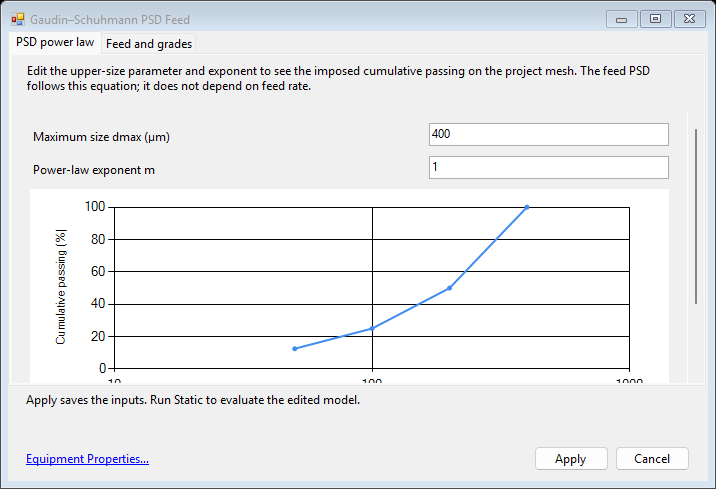
- Compare the curve preview against the measured size range and review pan mass. Apply and run to generate Product.
- In the stream Inspector compare the simulated PSD and composition by size with the measured feed.
Parameters and units
| Input | Units or options | Initial value or basis | Use |
|---|---|---|---|
| Feed solids flow rate | t/h, dry mass | 500 | Enter a finite, non-negative rate. |
| Feed water flow rate | t/h, water mass | 50 | Use the mass-basis water rate shown by this editor. |
| Maximum particle size dmax | µm | 60,000 | Use a positive size within the top project mesh aperture. |
| Power-law exponent m | Dimensionless | 1 | Enter a positive exponent fitted to the measured data. |
| Component PSD mode | Shared (0) or Individual (1) | 0 | Use a single distribution or separate maximum sizes and exponents for each solid component. |
| Component grades | % on the project display basis | Equal shares at initialization | Set the entered component shares. The first component closes the composition after conversion to the canonical dry-solids basis. |
Calculation and assumptions
Shared distribution
At aperture d, cumulative passing is a fraction of dry solids. The equation reaches 1 at dmax. Each retained fraction is the difference between passing at its upper and lower apertures. The finest aperture determines the pan mass.
P(d) = min[1, (d / dmax)ᵐ]
Retained in (dₗ, dᵤ] = P(dᵤ) − P(dₗ)
dₚ = dmax p^(1/m), where p is the passing fraction
Individual distributions
Apply the same power law to each component. With dry mass shares wⱼ, sum the component passing curves using those shares. For each size class, divide component retained mass by total retained mass to obtain its composition. DPSIM finds the mixture percentiles from the combined analytical curve.
P_mix(d) = Σⱼ wⱼ Pⱼ(d)
Class component grade = component dry mass in class / total dry mass in class
Calibration
Below dmax, a plot of log passing against log aperture has slope m. Fit from measured points with positive sizes and passing fractions between 0 and 1. Inspect both the coarse cut-off and fines before using one exponent for the full range.
Calculated results
| Result | Units or basis | How to interpret it |
|---|---|---|
| Analytical d50 and P80 | µm | Reported for the closed-form shared PSD or the dry-mass-weighted mixture. |
| Mass in pan | % of feed dry solids | Check against passing at the finest physical aperture. |
| Product dry solids, water and composition | t/h and % dry solids | Check per-component grade and the total mass after discretization on the project sieve mesh. |
Worked verification example
Use Shared with dmax = 1,000 µm and m = 2. Use sieves of 1,000, 500 and 250 µm, followed by Pan. Set 100 dry t/h and 25 t/h water.
| Check | Calculation or basis | Expected value |
|---|---|---|
| Passing at 500 and 250 µm | (500/1,000)² and (250/1,000)² | 25.00% and 6.25% |
| Retained between 1,000 and 500 µm | 100% − 25% | 75.00% |
| Retained between 500 and 250 µm | 25% − 6.25% | 18.75% |
| Pan | Passing at 250 µm | 6.25% |
| Analytical d50 and P80 | 1,000 × 0.5^0.5 and 1,000 × 0.8^0.5 | 707.1 and 894.4 µm |
Diagnostics and calibration
| What you see | What to check |
|---|---|
| Maximum size rejected | Use a positive value at or below the top project sieve. Check the selected display unit. |
| Entered component grades exceed 100% | Review the grade-display conversion and the closing first component. |
| Stream P80 differs from analytical P80 | Inspect the aperture spacing around the percentile. The stream calculation works on the discretized PSD. |