
The water ledger begins at the solids boundaries
At the design point of the preceding cases, the plant receives 100 dry t/h new ore. Grinding requires 100 t/h of externally supplied process water. Concentration adds 45 t/h to the grinding overflow. The resulting rougher tailings carry 84.6178 dry t/h and 133.3333 t/h water. The final concentrate carries 15.3822 dry t/h and 11.6667 t/h water. Within this case, concentrate water leaves the modeled boundary, with tailings thickener overflow and filter filtrate both eligible for return.
The tailings thickener retains all tailings solids in the underflow in the base calculation. Its underflow is 60% solids by wet mass. The filter turns these solids into a cake containing 85% solids by wet mass. These are imposed dewatering outcomes. They set a mass ledger without supplying equipment diameter, recovery of ultrafines, flocculant demand, cycle time, or power. A sedimentation flux model and filtration tests would provide the data needed to assess whether these outcomes can be sustained. Treating a clear overflow as a calculation assumption makes it possible to test that assumption later using suspended solids and grade. Kynch, 1952, sedimentation theory
For dry solids rate S and dry solids mass fraction φ in the wet slurry, water rate is W(S, φ) = S(1 − φ)/φ. With S = 84.6178 t/h,
| Overall dry or aqueous stream | Dry solids (t/h) | Water (t/h) | Role |
|---|---|---|---|
| Ground product entering concentration | 100.0000 | 100.0000 | Internal transfer |
| Concentration dilution water | 0 | 45.0000 | Demand at second destination |
| Concentrate leaving plant boundary | 15.3822 | 11.6667 | Final product and water loss |
| Rougher tailings to thickener | 84.6178 | 133.3333 | Internal transfer |
| Thickener underflow to filter | 84.6178 | 56.4119 | Internal transfer |
| Thickener overflow returned to water system | 0 | 76.9215 | Process water source |
| Filter filtrate returned to water system | 0 | 41.4793 | Process water source |
| Filter cake leaving plant boundary | 84.6178 | 14.9326 | Final tailings and water loss |
| Make-up with zero purge | 0 | 26.5992 | External input |
The tailings train returns 88.801% of the water it receives. Recovered water meets 81.656% of the total 145 t/h process water demand. They answer different accounting questions, with denominators of 133.3333 and 145 t/h, respectively. Make-up is 145 − 118.4008 = 26.5992 t/h, equal to cake plus concentrate water. This steady flow applies without evaporation, unreturned seal water, purge, or unrecovered spills. The complete circuit also returns the 100 t/h dry ore as 15.3822 t/h concentrate plus 84.6178 t/h filter cake.
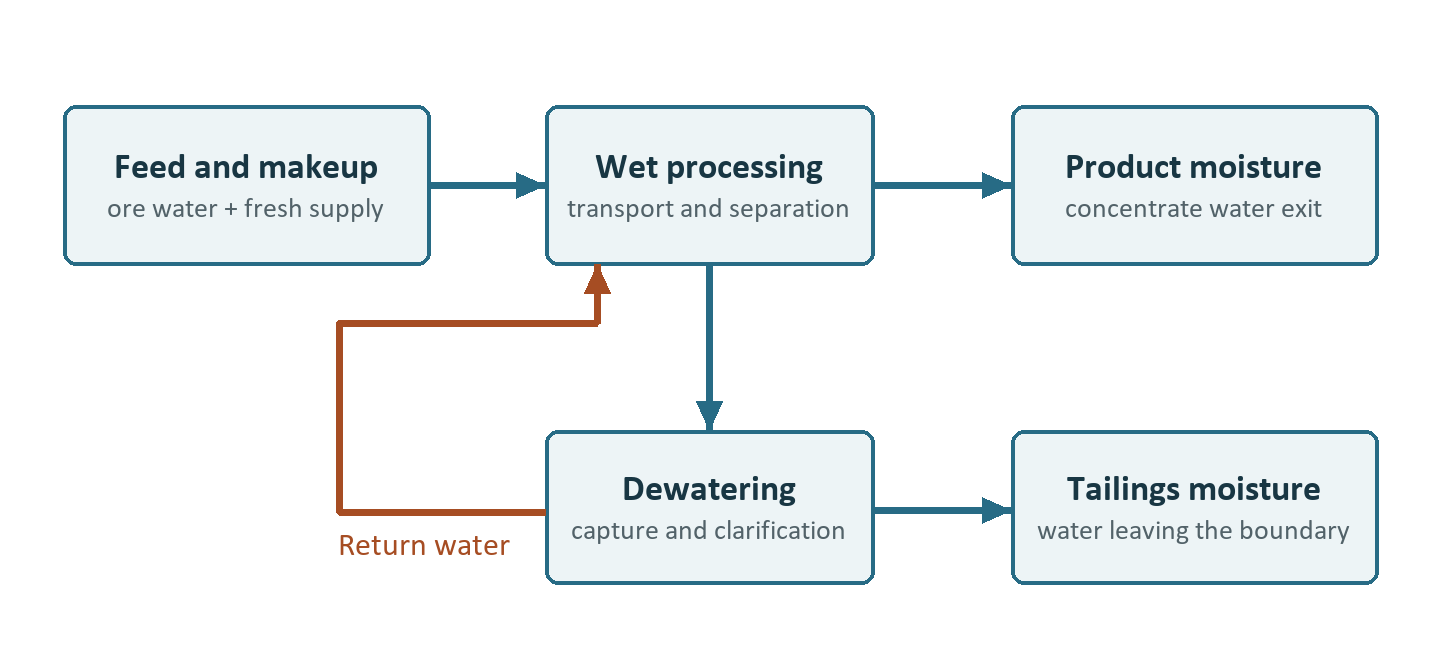
Moisture, circulation, and equipment duty
At fixed dry solids rate, increasing underflow dilution to 55% dry solids raises water to the filter to 69.2327 t/h and lowers thickener overflow to 64.1006 t/h. Relative to the base, 12.8209 t/h water moves from the thickener overflow route to the filter. If final cake water stays 14.9326 t/h and both returns remain usable, water recovered and make-up stay the same. Filter slurry throughput and filtrate duty increase, and the increased wet load can make the assumed cake moisture harder to achieve.
If cake solids instead fall to 80%, cake water rises to 21.1544 t/h and required make-up rises to 32.8211 t/h. Combined return drops to 112.1789 t/h. A water-balance backup case should therefore separate thickener underflow density, filtration capacity, cake moisture, and usable fractions of each return stream. If an overflow is cloudy or a filtrate contaminated, its recoverable volume may depend on the qualities the circuit can tolerate. Solids carried in recovered water require their own ledger and can alter the fresh ore interpretation in the preceding cases.
Quality sets a second closure equation
Suppose a conservative dissolved constituent enters with ore at J = 20 kg/h. Make-up concentration is zero. Assume constant liquid density 1.00 t/m³, no adsorption or reaction, and a well-mixed aqueous system in which purge, concentrate water, and cake pore water leave at the same concentration c. For loss volume Q₀ and purge P, solute balance gives
Here c is in kg/m³. Q₀ is 26.5992 m³/h, the sum of cake and concentrate water losses. A value of 1 kg/m³ corresponds to 1,000 mg/L. With zero purge, csteady = 751.90 mg/L. A 30 m³/h purge raises make-up to 56.5992 m³/h and reduces steady concentration to 353.36 mg/L. For a 300 mg/L illustrative specification, required total liquid loss is 20/0.300 = 66.6667 m³/h. Minimum modeled purge is 66.6667 − 26.5992 = 40.0674 m³/h, provided the target and purge destination apply to this boundary and the assumed mixing is supported. At that point, 78.3333 t/h of recovered water remains available and supplies 54.023% of the 145 t/h demand. The extra make-up follows directly from exporting the purged volume.
At constant volume V = 500 m³, switching from zero purge steady conditions to 30 m³/h purge reduces the model concentration towards 353.36 mg/L with time constant 500/56.5992 = 8.834 h. With a starting concentration of 751.90 mg/L, reaching 500 mg/L takes 8.83 h. The dynamic calculation distinguishes the concentration after one control period from the new eventual condition. In plant practice, dissolved species may change flotation, flocculation, and filtration response. The sensitivity needs chemistry or survey data, especially where a tracer assumption would miss reaction, retention, ionic mixing, or treatment. Le et al., 2020, dissolution tests for closed process-water circulation
Service during a reclaim interruption
Start from the zero-purge water case. A reclaim pumping interruption blocks thickener overflow for 2 h while filter filtrate stays at 41.4793 m³/h. Assume other flows initially remain at their nominal values and the missing overflow is retained in separate storage or routed out of the working water system. With baseline make-up fixed at 26.5992 m³/h, the process-water reservoir must supply 145 − 41.4793 − 26.5992 = 76.9215 m³/h. The required available draw above its minimum operating volume is 153.843 m³. If make-up can ramp immediately to 60 m³/h, the net withdrawal becomes 43.5207 m³/h and the 2 h usable volume requirement becomes 87.0414 m³. A usable 100 m³ covers the disturbance in the second scenario for up to 2.298 h. Start-up delays and continuing purge would use some of that allowance. The volume stored or routed away during the interruption must also accommodate the missing overflow stream.
The process model can feed a discrete-event treatment by assigning different returns to an operating, degraded, failed, or restored state. The change in process-water level can then trigger a production constraint, priority rule or an interlock. To compare designs, report hours below target mill water input, hours below target rougher dilution, fresh and reclaimed water usage, production and grade over the interval, and final inventory. Make-up reservation from another user adds a competing supply constraint. Such a study has to preserve both the no-outage base and the outage material integral. A steady flowsheet run can verify post-restoration flows when stocks return to their reference conditions.
A common acceptance basis for the three cases
Use consistent dry mass, water mass, size and mineral bases from grinding through filtration. Verify the grinding recycle class by class, the flotation circuit by mineral and water, and the produced cake by dry solids and moisture. Make the destination of each return flow and its availability explicit. Then test a held-out condition combining another ore population, grind, concentrate specification, and water return. The example chooses clear returned streams and a single conservative constituent to keep exact checks visible. Coarser distributions, water-quality feedback, evaporative losses and pump capacity add separate data and assumptions. The independently calculable base case remains a check on conservation and routing as that detail is introduced.
Exercises with answers
- Compute the current filter cake wet mass flow at 85% dry solids. Answer. 84.6178/0.85 = 99.5504 t/h. Its water rate is 14.9326 t/h.
- At baseline cake and concentrate water losses, find zero-purge steady concentration if J is 8 kg/h. Answer. (8/26.5992) × 1,000 = 300.76 mg/L.
- A 100 m³ usable reservoir starts full. In the two-hour interruption, make-up stays at 26.5992 m³/h for the first 30 min before rising to 60 m³/h. Is the volume adequate? Answer. Required draw is 0.5 × 76.9215 + 1.5 × 43.5207 = 103.742 m³. Shortfall is 3.742 m³ unless process flow is reduced or another supply is available.
- Why does water recovered from the tailings train remain unchanged when underflow is diluted at fixed final cake solids? Answer. Thickener overflow decreases by the amount that filter feed water increases. Filtrate rises by the same amount while cake water is held, so their sum is conserved.