
Mineral Process Modeling

From Particle Populations to Plant-Wide Simulation

An engineering textbook with worked calculations, exercises and plant-wide case studies.
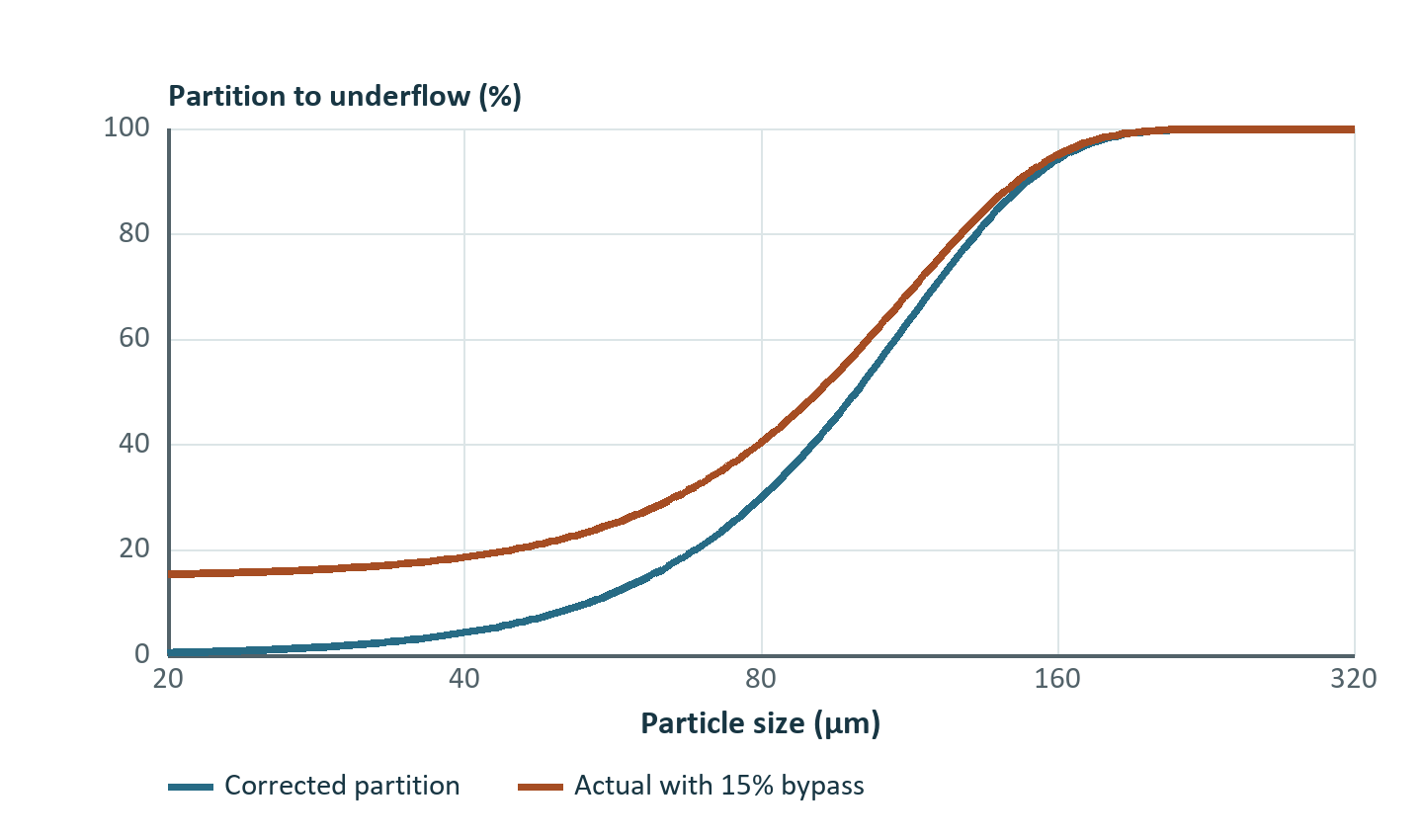
Plot contrasting corrected and actual hydrocyclone underflow partition by particle size.
Corrected and actual particle partition to hydrocyclone underflow.

Table of contents

34 chapters and 4 appendices

Part I

Material, Measurements, and Balances

Represent a particle population, interpret sieve and assay data, and close the dry solids and water balances.

  1. 1Particles and process questions
  2. 2Sieve data and particle size distributions
  3. 3Sampling, assays, and reported uncertainty
  4. 4Process balances and stream constraints
  5. 5Parametric descriptions of feed size
Part II

Comminution and Population Balances

Model the size and power duty of crushers, grinding rolls and mills.

  1. 6Energy, power and product size
  2. 7Capture, breakage and escape in crushers
  3. 8High-pressure grinding rolls
  4. 9Population balances for milling
  5. 10Mill discharge, grinding stages and inventory
Part III

Classification and Partition

Calculate size-dependent routing, actual and corrected partition, water bypass and capacity.

  1. 11Size partition, component recovery and water bypass
  2. 12Screening capacity and particle passage
  3. 13Fine wet screening and dewatering
  4. 14Hydrocyclone hydraulics and classification
  5. 15Air, gravity and inverse classification
Part IV

Concentration and Separation

Connect particle properties, separation mechanisms, grade and recovery.

  1. 16Concentration as a partition problem
  2. 17Gravity concentration and enhanced gravity
  3. 18Dense medium and magnetic separation
  4. 19Flotation kinetics and rate distributions
  5. 20Froth transport and column flotation
Part V

Water, Slurry Transport, and Dewatering

Track hydraulic capacity, solids flux, cake moisture and the quality of recovered water.

  1. 21Slurry properties, dilution and water accounting
  2. 22Slurry pumps and open launders
  3. 23Sedimentation, thickener duty and inventory
  4. 24Filtration and vibrating-screen dewatering
  5. 25Process-water recovery and reuse
Part VI

Calibration and Flowsheet Simulation

Reconcile surveys, select models, fit parameters and solve recirculating circuits.

  1. 26Survey data and balance reconciliation
  2. 27Calibration, identifiability and model selection
  3. 28Predictive uncertainty, verification and scale-up
  4. 29Numerical flowsheets and recycle convergence
Part VII

Dynamics and Integrated Case Studies

Use material inventories, feedback and reliability to understand plant-wide response.

  1. 30Material inventories, transport, and control
  2. 31Discrete events, reliability, and production
  3. 32Case study of closed grinding and classification
  4. 33Case study of concentration with cleaner recycle
  5. 34Case study of water recovery and the integrated plant

Appendices

Study notation, solve additional calculation exercises and consult the bibliography.

  1. ANotation, units, and dimensional checks
  2. BCalculation laboratories
  3. CBibliography and source guide
  4. DIndex of DPSIM model coverage